Japan and Us
Speech by Walter Wüst, President of the Ahnenerbe, Munich, 30 April 1942

Mr. Ambassador!
Mr. Reichsstatthalter!
Ladies and Gentlemen!
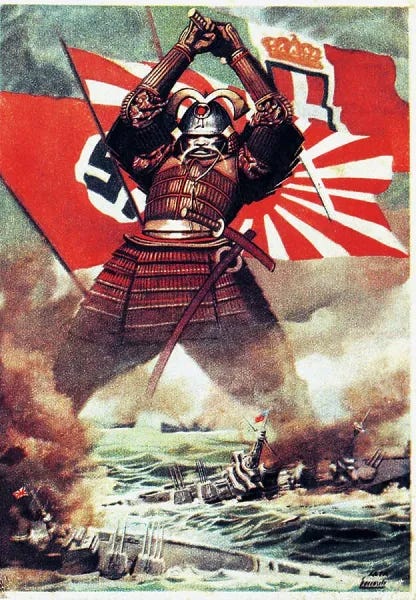
Since Japan entered the present world conflict on December 8, 1941, it has presented one riddle after another both to its deadly enemies and to its astonished — indeed admiring — friends and allies. Without being exhausted or bled dry by its four-year-long bitter struggle on the Asian mainland against the Chinese colossus — as the two Western powers and their satellites so badly miscalculated — Japan has, through an unprecedented assault, achieved in ninety days of war and ninety days of victory what could already be seen by early March 1942: it has risen from a great power to a world power of the highest rank.
People everywhere keep asking themselves how all this was possible: the devastating blow against the American battle fleet right at the beginning of Japan’s entry into the global struggle, the fall of the supposedly impregnable British strongholds of Hong Kong and Singapore — Japan’s “golden hour” —, the uncanny mathematical precision and straight logic of the campaign plan, the death-defying courage of all branches of the armed forces, highlighted by the feats of the two-man submarines and torpedo planes, the vast distances this war has been fought over, and finally the enormous territory itself. In just the past three months, Japan has taken in nearly 3.8 million square kilometers — eight times the size of Germany before the National Socialist takeover — along with about 100 million people, of whom roughly 50 million live in the Dutch East Indies, plus previously unimaginable raw material resources. All of this has been integrated into the building of Greater East Asia, and the process is clearly far from finished.
Old ideas fade, certainties collapse, and standards shift — even for the cool, sober observer who sees in Japan’s advance the same steady mix of bold progress and careful consolidation that marked the Meiji era, or who traces the growth of this empire to the unmistakable seafaring genius of its island nation-builders. Yet even he stands somewhat speechless when he sees this same Japan now preparing to leap upon England’s most valuable possession — India — striking at a region that has never before in world history been seriously threatened from that direction.
Indo-Germans, Indo-Scythians, Arabs, Afghans, and especially the Mughals, together with the European colonial powers — the Portuguese, Dutch, French, and English — all came to rule Indian soil from the west or northwest, whether by sea or by land. Japan, by contrast, is now advancing against India for the first time from the east and southeast with its navy, air force, and army in a broad, staggered front. In doing so, it is connecting itself to a long-forgotten Austro-Asian tradition of conquest. Yes, it is true: before our very eyes, world history is taking on a new shape in its essential features, and it is Japan, with full demonic force, that is shaping this mysterious new form.
The meaning and conclusion of these events are inescapable. For those who witness these events as friends, they mean understanding “the spiritual front of the Tripartite Pact” by seeking to grasp in its depths this people of the East that poses riddles to us all. Only a few years ago, a Japanese professor complained in unusually instructive words that his country had too many lawyers and too few raw materials. Only a few weeks ago, ancient Japanese court music, masterfully arranged by Hidemaro Konoye, sounded over German radio in all its dark strangeness — with its broken yet stirring rhythms of trombones and the lamenting sequences of horns. We may have thought then of the few Japanese words that stand like stray boulders in our mother tongue — I mention only in passing: bonze, harakiri, mikado, samurai — and we felt newly obliged to reflect deeply on what Japan is and what Japan wants: to descend into the sources of this concentrated “living spiritual power,” this “tremendous strength of spirit,” which a Japanese living among us recently named, quite clearly, as the ultimate and deepest cause of victory and greatness.
No people on earth is more entitled or better equipped to undertake this examination of the Japanese national character than the German people. For German scholarship and German wisdom have, for roughly a century and a half — especially in the field of linguistics — uniquely developed and refined the art of comparison in the history of human thought. This allows us, despite all the difficulties involved in applying it to something as utterly foreign as Japan, to make such a comparison with full responsibility. Moreover, German scholarship earned this right through decades of selfless training of Japanese technicians, lawyers, doctors, pharmacists, philologists, and psychologists — training that the Japanese themselves warmly acknowledged. At this turning point in German-Japanese cultural relations, German scholarship has every justification to look with affection upon its former model pupil, now grown great and strong, and today a fully independent ally.
The surprising parallel course of Japan and Germany in political matters has been observed again and again since the First World War. It must not be forgotten, however, that National Socialism, with its renewed appreciation of the unique value of foreign peoples, has opened even wider paths for this understanding. Even ordinary people who are neither politicians nor scholars can easily see the pieces of this parallelism: the threat from hostile neighbors, the narrowness of national territory — two peoples without living space! —, the lack of essential raw materials, and the resulting common opposition to the over-satisfied Anglo-Saxon exploitative democracies allied with Jewish world capitalism. No less important is the soldierly spirit of the front-line experience and front-line comradeship emphasized by both Germans and Japanese. All this flowed into originally modest but ever-growing renewal movements whose highest goal — to speak with you, General Oshima — was “to achieve a world order of justice.”
Yet beyond that, it would be wrong to believe that mere historicism or a chronology of dynasties could convey the inner attitude toward the ideological development of the Reich idea. What matters is not the sequence of events but the broad geopolitical and ethnopolitical overview. For real mutual understanding between Greater Germany and Greater Japan, we must dig deeper if we wish to stand on truly essential foundations. Once we reach these clearly visible layers, the knowledgeable observer is deeply impressed by the breadth and density of the connections that bind Japan and Germany together. He is all the more impressed because each element corresponds strictly to the others. Thus, today’s Greater Germany is inspired by the Führer idea, a magnificent elevation of ancient ducal and royal concepts, while Japan’s Tennō has from the very beginnings of Japanese history served as the “living god,” the embodiment of State Shinto and the religious center of the entire state leadership. Emperor and people are mythologically of one blood, both are kin — just as with us the Führer is in the truest sense the father of the nation.
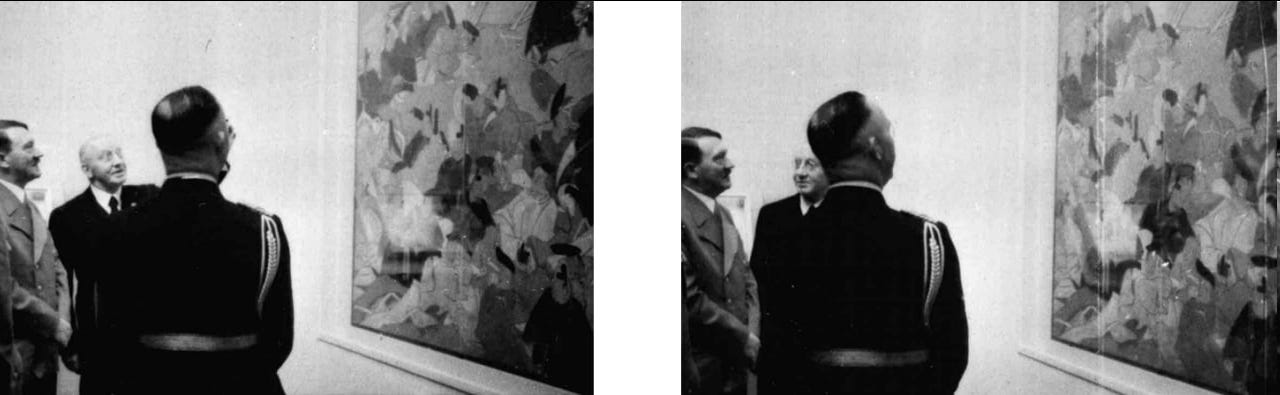
From this basic attitude flow cultural consequences that lead naturally to the clan idea, to an independent peasantry, to ancestor veneration (whose customs in Japan and Germany not coincidentally use the same memorial tablets), and finally to the comprehensive idea of the national community. In both countries there were periods when a “foreign state culture” temporarily overran this idea. Even today in Japan, forms of the old loyalty contract survive here and there. In naming this we also arrive at its root cause: German knighthood and Japanese samurai culture, the noblest flowers of civilization among our friends as among ourselves.
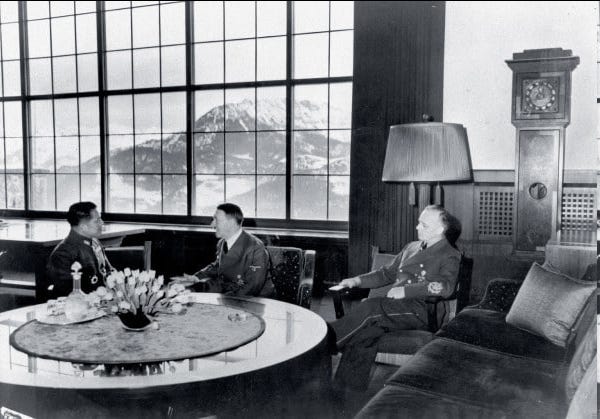
Today we have the good fortune to have among us, in the person of General Oshima, a true samurai. Sincerity and justice, courage in daring and in endurance, benevolence and courtesy, readiness for battle, and that self-mastery which rises all the way to seppuku — these are the elements of Bushidō, just as they are the virtues of the Germanic knight and nobleman.
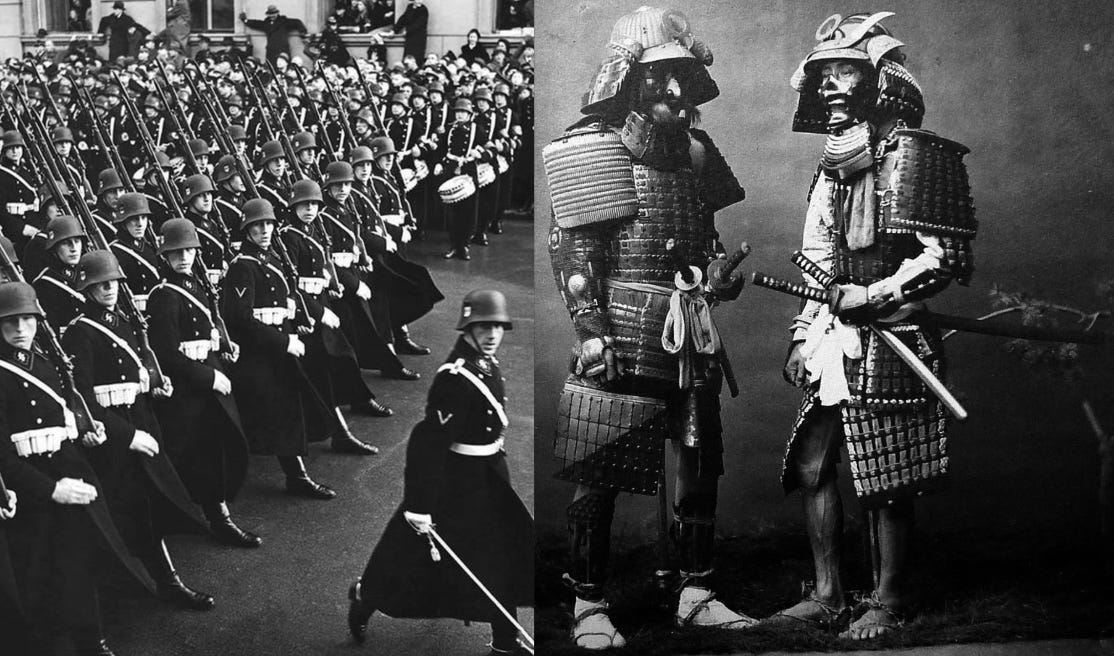
It is no accident that a book on the samurai was published by the Central Publishing House of the NSDAP with a foreword by Reichsführer-SS Heinrich Himmler. Nor is it accidental that samurai and German knights helped shape the Reich that is now being gloriously built in Europe and East Asia after long isolation and repeated attempts at renewal.
That this Reich is always conceived as something coming into being rather than already complete — that it remains a realm of our longing — places the deeply rooted patriotic idea of both Japanese and Germans squarely within nature itself. A German visitor described the shrines of Ise with great admiration, noting that every high official and military officer goes there upon taking or leaving office to report to the highest divine ancestors of Japan.
We listen with admiration, for we have nothing quite like it. Yet beyond these differences, the threads run strong and close — in the experience of nature, in the love of gardens, and in the shared idea of the mountain. One keen observer believes he sees a remarkable parallelism in the stylistic periods of kindred national souls. For my part, I see a continuous line from the so-called impersonal thinking of the Japanese to the National Socialist collective thinking, or the same pattern in the relationship of Buddhism to Shinto as in Christianity’s relationship to a pre-Christian, purely German faith. Beneath the leveling cloak of a world religion foreign to climate and race, the ancient blood currents break through with the victorious strength that belongs to young peoples secure in their ancestral heritage.
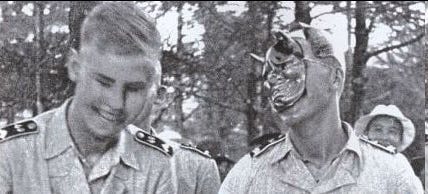
A Japanese once said: “It has been claimed that Japan won its last war against China only with Murata rifles and Krupp cannons. These are only half-truths. The most perfect weapons do not fire by themselves. No — what won those battles were the spirits of our fathers, the spirits of our warrior ancestors. Take even the most modern-thinking Japanese, and an ancient samurai steps forward. If you wish to plant a new seed in his heart, you need only stir up the deep sediment that has gathered there for centuries.”
This man was filled with the profound power of tradition — the very type of man we in Germany are fortunate to still possess, but which we must deliberately cultivate in far greater measure if we are to secure the victory of our arms and fulfill the deepest meaning of our Greater German Reich.
May Providence grant that this young yet eternal German man matures quietly and steadily in the same spirit that is inborn in the Japanese when they pray before ancient shrines that are nevertheless rebuilt new and pure every twenty years. For therein lies a beautiful symbol of the intertwining of the present and the eternal.
Out of this deep spiritual intertwining there has grown over roughly three hundred years a dense network of relations between our two peoples. To describe all these developments in detail would exceed the time and scope available to me. I must therefore limit myself to this excerpt.What Germany and its culture owe to the far-sighted support of Your Excellency, Ambassador Oshima, is firmly in our consciousness. The Führer himself visibly acknowledged it by awarding His Excellency the Grand Cross of the Order of the German Eagle in Gold on December 13, 1941.
Under the symbol of those two trees whose trunks and branches grow toward each other — one planted by Robert Koch for Kitasato, the other by Kitasato for Koch — I thank you for the honorable trust shown me by my appointment as president of the newly founded German-Japanese Society in Munich. I accept this appointment and ask all who share this spirit to join me, under the honorary presidency of our respected Reichsstatthalter General Ritter von Epp, in helping to build this great common work of the past, the present, and the future!